The Belgian Electricity Market:
Where Flexibility Becomes Savings
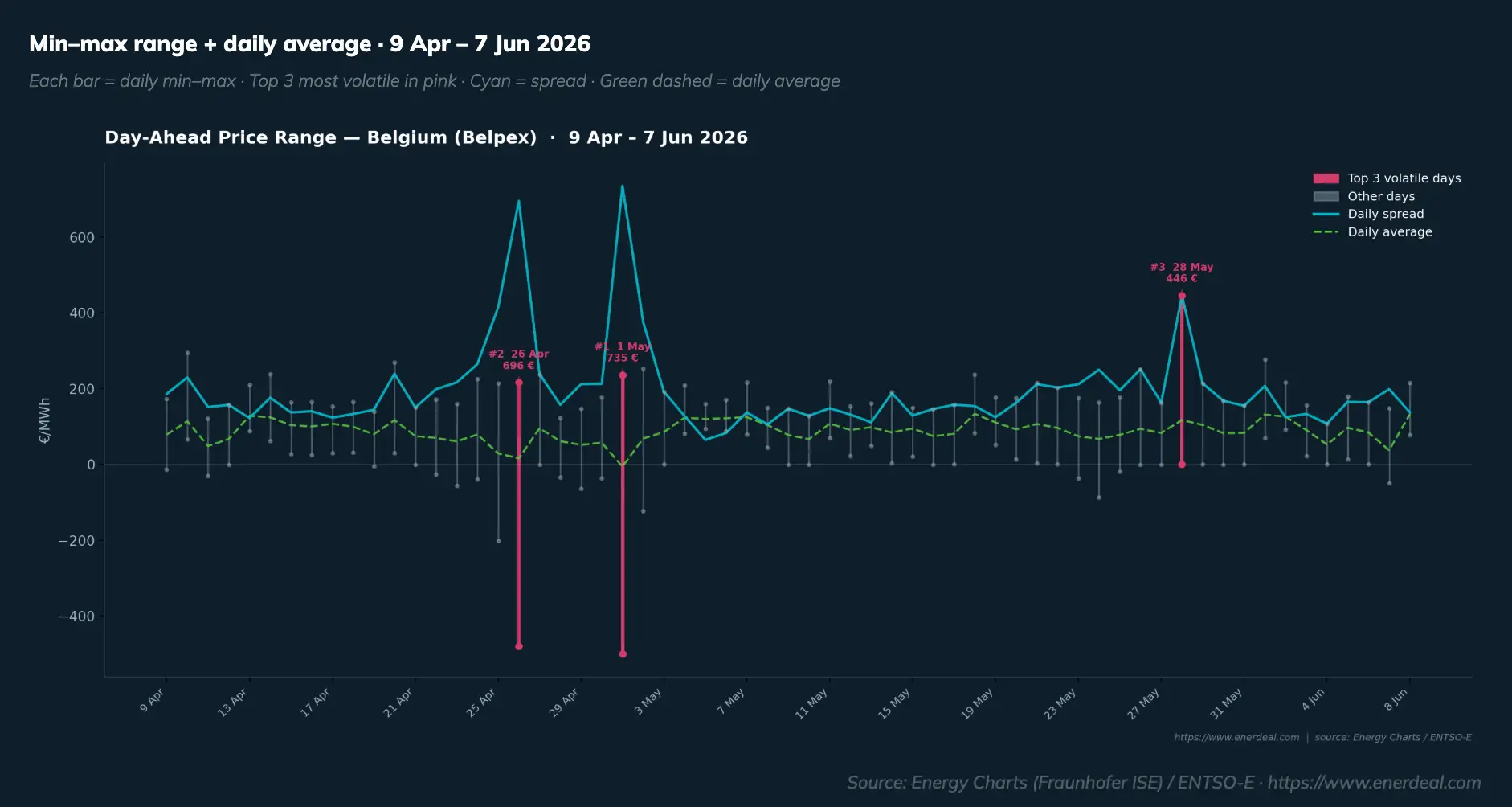
The Belgian electricity market has become much more dynamic. For a company capable of adjusting its consumption or managing a battery, these price fluctuations become a way to save money. These two dashboards track the Belgian market over the past 60 days.
Day-ahead Prices
The summer of 2026 confirmed what the rise of solar power had made foreseeable: the Belgian market has become structurally arbitrageable. From June to August, the midday trough fell below night-time prices on 99 per cent of days, and around the solar peak, prices dropped to near zero in a large proportion of the quarter-hourly periods.
The peak-to-trough spread averaged €171/MWh, compared with €115/MWh in 2024 and €131/MWh in 2025 – an increase of nearly 50 per cent in two years. Energy has never been so cheap at midday, and the value of flexibility has never been so high.
Sites combining on-site solar, storage and optimisation have turned this spread into a competitive advantage, with significant cost reductions across several tens of GWh of annual consumption. This is the approach EDP is rolling out among its industrial customers, illustrated in the heating sector by the Paper Prime project in Portugal.
What autumn redistributes
Solar generation declines, the curve narrows, and morning and evening peaks regain value. For sites equipped with solar and storage, this shift is not bad news: it simply redistributes value across different hours.
What the energy regulation changes
The energy standard provides for a reduction in transmission tariffs for large consumers, and a general reduction in electricity excise duties. Part of the regulated bill is reduced. What remains is the price of energy, which continues to vary from hour to hour, and over which the site retains the greatest control.
What this means for management
In summer, an EMS would time-shift consumption to coincide with periods of low solar output. In winter, it smooths out evening peaks and manages storage across the two daily peaks. The levers lie in the processes: furnaces, compressors, grinding, refrigeration, and storage of intermediate products. An EMS does not change the process; it simply chooses when it runs.
Beyond electricity
For sites that also consume heat, an electric boiler installed alongside the gas boiler generates steam using the cheapest energy source at any given hour.
Our approach
Using your hourly data, we calculate the savings that optimisation would have delivered this summer and the potential savings this winter, covering both your flexible electricity consumption and the portion of your heating requirements that can be met by electricity.
Imbalance Market
Industrial flexibility: what the Belgian imbalance market showed this summer, and what’s changing this winter
The imbalance prices published by Elia reflect, quarter-hour by quarter-hour, the actual state of the Belgian grid. For a large industrial site, they indicate when its flexibility is most valuable.
What the summer showed
During the sunniest months, imbalance prices regularly fell below zero, because Belgian solar power now generates, at certain times, more than the grid can immediately absorb. These windows of opportunity are remunerated: the grid needs someone to consume or store the excess, and it pays for it. Sites equipped with storage have turned these signals into direct gains.
What autumn and winter hold in store
As hours of sunshine decline, negative prices become scarcer and upward pressure returns, particularly on cold mornings and evenings when demand is high. In winter, flexibility pays off when a site can reduce its consumption, or feed power into the grid, at times when the grid is short of supply. These moments are hard to predict, hence the value of automated control.
As the energy standard is introduced, Belgium’s federation of enterprises points out that it will be necessary to combine grid development, flexibility and better management of connections to contain the costs of an economy that is becoming increasingly electrified. In our view, large consumers are on the front line: they have the greatest potential for flexibility.
What this means for your site
Flexibility lies first and foremost in the processes: a load that can be interrupted, slowed down or shifted by a few quarters of an hour without affecting final output. Storage capacity of several MWh provides further leverage, and an EMS connected to Elia’s signals can adapt its strategy to the season using the same equipment.
Sites that generate heat have an additional lever: an electric boiler alongside the gas boiler allows them to consume more electricity when prices are low and switch back to gas when the grid is under strain. This is the hybrid approach we outline in our analysis of the Paper Prime project, which can be applied to industrial sites in Belgium, Luxembourg and France.
Our approach
Using your actual consumption and generation data, we simulate what dynamic control would have yielded this summer and what it could achieve this winter, to balance process flexibility, storage and the electrification of part of the heat.